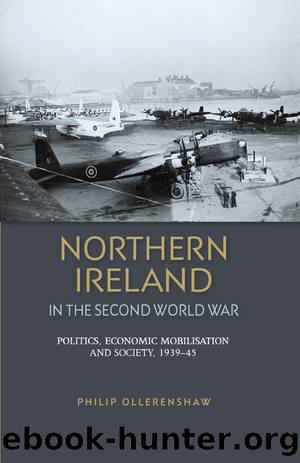
Northern Ireland in the Second World War: Politics, Economic Mobilisation and Society, 1939â45 by Philip Ollerenshaw
Author:Philip Ollerenshaw [Ollerenshaw, Philip]
Language: eng
Format: epub
Tags: History, Europe, Great Britain, General, Ireland, Military, World War II, Modern, 20th Century, Social History
ISBN: 9780719090509
Google: 8uSmyAEACAAJ
Goodreads: 18005012
Publisher: Manchester University Press
Published: 2013-10-08T00:00:00+00:00
Table 3.6 Industrial disputes and strikes in Northern Ireland, 1941â45, by industry
Unofficial strikes caused by wage disputes, transport difficulties and other, often quite minor, issues within the workplace, the optimum use of skilled and other labour and the creation of a pool of skilled labour through extensive training were seen as the most important obstacles facing Northern Irelandâs industrial expansion.185 In attempting to overcome the production problems it faced, the Northern Ireland Ministry of Commerce sought assistance from government officials in Scotland, three of whom, the Regional Technical Officer and his Deputy, and the Labour Supply Officer, visited shipbuilding, engineering and aircraft manufacturing plants in the region early in 1942.186 The main solution was the appointment of a Labour Inspectorate along the lines already established in Scotland. In Northern Ireland, they identified a âdefinite lack of co-operation and goodwill, almost amounting to suspicion amongst employers, management and employeesâ. Some of this was due to supervisors who, while âcapable in the technical senseâ lacked âthe aptitude for handling man-power efficientlyâ. In other cases, âoverzealousâ trade union officials were to blame.187 With regard to unofficial strikes, the Scottish experience had been that Labour Supply Officers were crucial in addressing issues which if left alone were likely to lead to an industrial dispute.
While the appointment of Labour Supply Officers made the government of Northern Ireland much more interventionist, it is clear that both employers and trade unions, who had criticised the government for not intervening more often in labour supply, welcomed the move. There was also general agreement that the Scottish model would suit conditions in Northern Ireland. Two Labour Supply Officers were appointed shortly thereafter, one on secondment from Harland and Wolff and the other a senior official in the AEU, and both with military service records in the First World War.188 In taking this step, the government was belatedly responding to a need which had been obvious at least since Harold Macmillanâs visit to the region a year before. This may have been too late to make a major difference to the settling of disputes but could perhaps have prevented minor grievances from escalating into strikes. Nevertheless, there continued to be major disputes.
In October 1942, an unofficial strike at Short and Harland over the question of Sunday working led to the sacking of two shop stewards. It was this dispute which led to the development of the Belfast and District Shop Stewardsâ Movement to co-ordinate strike action in key factories. Despite the relatively high number of prosecutions of striking workers in Northern Ireland compared to Britain, industrial relations showed no sign of improvement in the later stages of the war. This was so even though the local and national Communist Party leadership sometimes did much to persuade strikers to return to work, with mixed success.189 During the 1942 dispute at Shorts, William McCullough of the Communist Party in Belfast declared: âToday the streets of Stalingrad, the Volga river and the country between it and the Don are drenched in blood yet
Download
This site does not store any files on its server. We only index and link to content provided by other sites. Please contact the content providers to delete copyright contents if any and email us, we'll remove relevant links or contents immediately.
The Vikings: Conquering England, France, and Ireland by Wernick Robert(84431)
Ali Pasha, Lion of Ioannina by Eugenia Russell & Eugenia Russell(40338)
The Conquerors (The Winning of America Series Book 3) by Eckert Allan W(38126)
The Vikings: Discoverers of a New World by Wernick Robert(37027)
Cecilia; Or, Memoirs of an Heiress — Volume 1 by Fanny Burney(32663)
Cecilia; Or, Memoirs of an Heiress — Volume 2 by Fanny Burney(32029)
Cecilia; Or, Memoirs of an Heiress — Volume 3 by Fanny Burney(32012)
Empire of the Sikhs by Patwant Singh(23151)
The Secret History by Donna Tartt(19365)
Hans Sturm: A Soldier's Odyssey on the Eastern Front by Gordon Williamson(18675)
Cat's cradle by Kurt Vonnegut(15476)
Pimp by Iceberg Slim(14719)
Sapiens: A Brief History of Humankind by Yuval Noah Harari(14485)
Norse Mythology by Gaiman Neil(13482)
Talking to Strangers by Malcolm Gladwell(13477)
Leonardo da Vinci by Walter Isaacson(13433)
4 3 2 1: A Novel by Paul Auster(12552)
Underground: A Human History of the Worlds Beneath Our Feet by Will Hunt(12176)
The Radium Girls by Kate Moore(12123)
